
Hello, Barnsley!
Introducing Starship
FAQ
Who is Starship?
Starship was founded by the engineering team behind Skype. Our CEO Ahti Heinla entered a NASA competition to build a robot to collect rock samples on Mars - he didn't win the competition but was inspired to look at what his invention could deliver closer to home.
Starship was founded in 2014 and has been making deliveries since 2018. Though Ahti is Estonian, the UK is Starship's second home - the first ever commercial deliveries for Starship were made in Milton Keynes, and since then we've made more than 2 million deliveries in communities across the country, including in Leeds, Wakefield and Greater Manchester.
Why robot delivery?
Demand for on-demand delivery has grown enormously in recent years. Residents increasingly expect to be able to order a small number of items and have them arrive quickly. If you think back even ten years ago, this sort of delivery style and volume just didn't exist.
The question for us all is how we meet people's expectations ethically and sustainably. Robot delivery is one part of that picture, working alongside human couriers as part of a multi-modal solution, freeing people up to handle the deliveries that need a human.
What about jobs?
Demand for delivery is growing. Last-mile delivery is expensive and carbon intensive. What we offer isn't replacing jobs but meeting new demand and helping businesses to structure deliveries in the most efficient way - letting robots handle the parts that don't always make sense for humans to do. Human couriers work hand-in-hand with robot delivery.
But Starship operations create jobs too. We need robot technicians and field assistants on the ground to maintain and support our fleet day-to-day. We have a hub in Yorkshire, and the more the service grows the more jobs we can create.
Research we conducted last year showed that scaling UK operations and manufacturing could generate over 550 quality technology jobs nationally.
How do they actually work?
The robots are 99% autonomous. We've developed that autonomy level over the last 11 years. When the robots first started out, they were accompanied by a human supervisor - we've come a long way since then!
They use a combination of cameras, sensors and computer vision to navigate the world. They understand humans, wheelchairs, cars, traffic lights - the whole range of things you'd expect to find in a town or city. They can measure the speed of vehicles coming towards them.
The robots learn with every journey, so after close to 10 million deliveries made across eight countries, they've learned a lot! That's what makes our autonomy levels so high and so safe - they've had tens of millions of interactions, and they are learning more all of the time. You can see more about the robots here.
What about data and privacy?
In the world we live in, we completely understand that people are concerned about data and privacy.
Starship robots use cameras and sensors to navigate the world around them. Cameras and sensors help the robots to recognise that there is a person on the pavement ahead, to cross a road safely, or avoid an obstacle.
We want to be very clear: we are categorically not seeking to collect or use personal, identifiable data from the cameras for any reason. In certain situations involving the prevention or detection of a crime, we may share limited data collected from our robots with law enforcement officials, subject to applicable law and Starship policy. We genuinely don't want people's personal data, we go to great lengths to avoid capturing it - and the robots don't need it. They need to identify that a person is in front of them, not who that person is.
The cameras sit at knee height, blurring is done automatically, and the robots carry no audio recording capability whatsoever - they are not listening to anything in their surroundings. We use various methods to anonymise and minimise personal data such as obscuring the feed, using low resolution cameras and utilising live streams where possible. We delete all data, keeping only essential information to help robot learning or if there is an incident — even then it is still obscured.
All Starship data is stored within the EU, and for those familiar with data protection law, we comply fully with GDPR.
How do you work with the disability and accessibility community?
We take accessibility very seriously, that's why we meet with local disability groups and continually work with disability charities nationally.
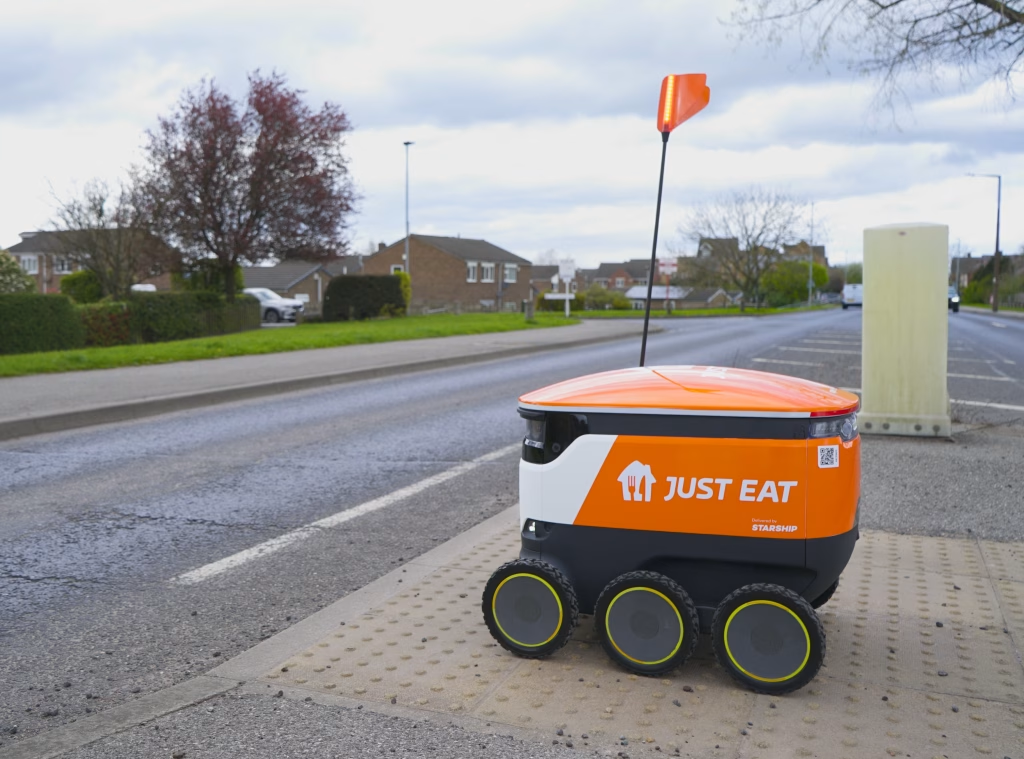
Robots will slow down if they see a human, mobility device or pushchair approaching. They are programmed to be cautious. Our robots are also designed to identify mobility aids and wheelchairs, triggering additional caution and human oversight whenever one is detected. Our orange LED flag was developed with sight loss charities to make the robots stand out for people with low vision. We are working with sight-loss charities to help robots better understand canes and cane user movement. Underpinning all of this is our Accessibility Advisory Panel, which brings together people with lived experience of disability to ensure accessibility is central to how we design and operate our service — this is not an afterthought to us.
Notably, 25% of our regular customers identify as disabled or live with someone who is — the service provides real benefit to those with mobility challenges.
How fast are the robots and how heavy are they?
Our robots weigh 38kg and travel at an average speed between 1.8mph - 2.5mph - roughly walking pace. They are designed to be cautious around people, and they modify their speed depending on their surroundings. They travel on pavements and behave like careful pedestrians, slowing down when they see anyone ahead of them.
What happens if a robot breaks down or gets stuck?
Our robots let us know if something is wrong. A team member can log in remotely to assist or, if needed, a Field Assistant can attend in person. The robots are monitored at all times (a little bit like a robot version of air traffic control) so they're never just left to fend for themselves.
What happens if a robot is in an accident?
It doesn't happen often, but with all modes of transport sometimes accidents happen.
The robots are designed and programmed to avoid contact - they will stop or move out of the way rather than bump into anyone or anything. If contact does happen, because of their low weight and speed the maximum impact is just 52 joules, which is around 14 times less than a person on a bicycle.
The entire fleet is insured, and Starship is the sole point of liability.
What are the benefits for Barnsley?
Small businesses get access to world-leading tech: For the first time in Barnsley, small businesses have access to world-leading tech without needing the significant up-front investment it would take to go it alone. Last-mile delivery is carbon intensive and expensive — robot delivery can help small businesses compete, grow and reach more customers.
Reduction in car journeys: Our customer surveys show that over half of our UK customers would have driven to collect their order had robot delivery not been available. We estimate that across UK and EU operations, zero-emission robot delivery has already reduced carbon emissions by over 700,000kg.
Children love the robots: Across the globe, children embrace our robots like no other group. Whether it's a child dressed in a unicorn costume dancing along to a robot singing Baby Shark in Finland, kids in Milton Keynes chasing Easter Bunny Bot down the road to hug it, or robots delivering Christmas gifts on a children's ward in Leeds — children have a real affinity for the little guys and gals.
We use that enthusiasm through our Starship Schools programme to talk about jobs in engineering, technology and robotics. We're looking forward to visiting schools in Barnsley.
Where do you deliver and how do I order?
Starship delivery is a great way to help small businesses access robot delivery. Just open our partner's delivery app (Eg. Uber Eats, Just Eat, Grubhub, Bolt, foodora, S-kaupat) and you'll be able to see which local merchants are available for robot delivery in your area. If you're in the service area, a robot will be offered as a delivery option at checkout.
A Starship delivery uses as little energy as it takes to boil a kettle for a single cup of tea.